When AI jobs can wait, they pay less for power. OPAIRS does it automatically.
Electricity is not a fixed cost: it fluctuates hourly. OPAIRS uses the aWATTar API to shift AI inference and automations into low-price windows. The result: measurable returns, predictable costs, and no loss of functionality.

Cloud providers hide their energy costs inside token pricing. Anyone running AI on-premise sees power consumption directly, and can control it. That is exactly what OPAIRS does: compute-intensive tasks are not simply executed when they arise, but when electricity is cheap. Automatically, without manual intervention, and without limiting functionality.
aWATTar Integration: Spot Market Electricity Prices as a Control Signal
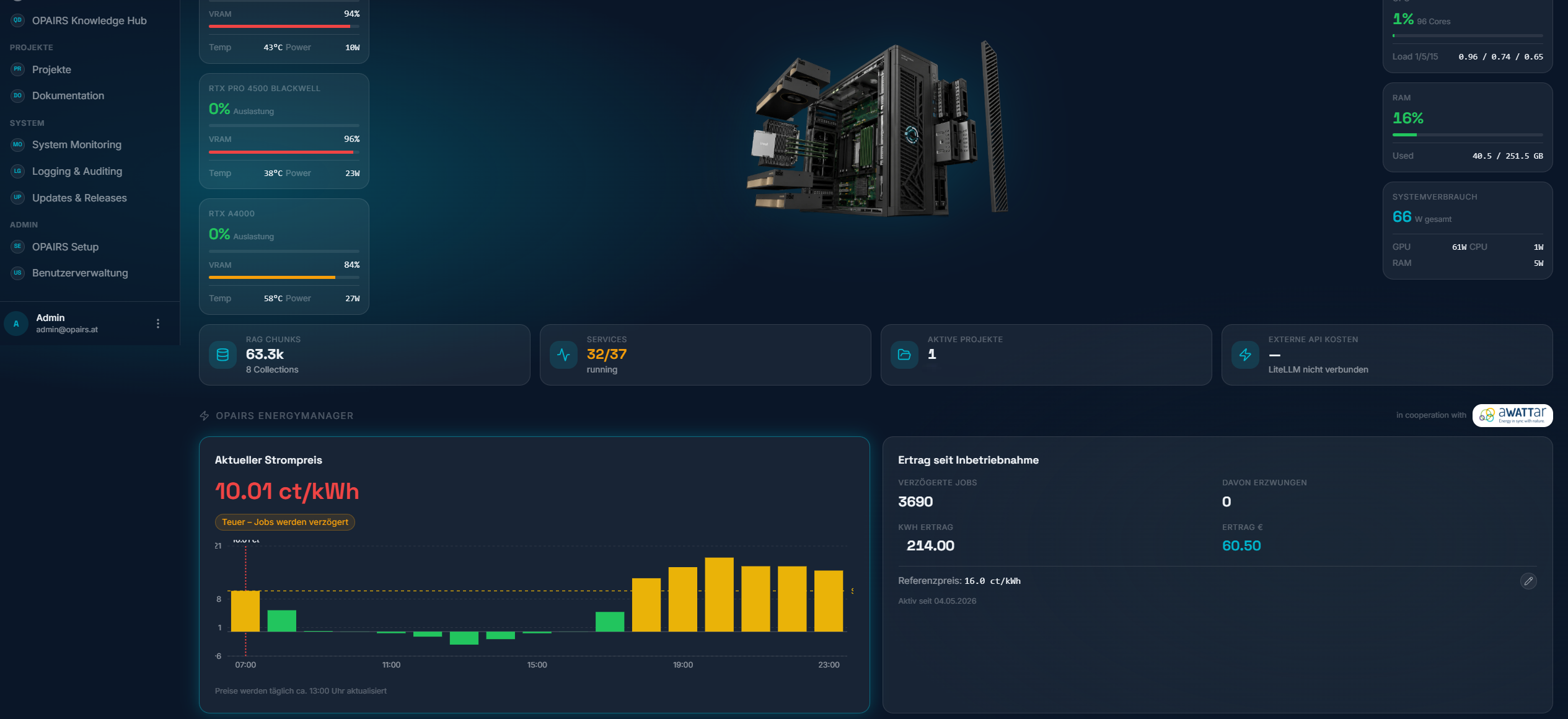
Real-time prices directly in the OPAIRS stack
OPAIRS integrates the aWATTar API for hourly EPEX SPOT electricity prices. The system knows the current price per kWh as well as the expected trend over the next few hours. If the price is above the configurable reference value, the EnergyManager automatically shifts non-critical jobs to the next low-price window. If it is below, all processes run without delay. The reference price is freely configurable per installation, so companies with their own PV system or an industrial power tariff can adjust it accordingly.
Three Job Classes – One Clear Prioritization
- Immediate – time-critical requests: User interactions, alarms, and real-time evaluations always run right away, regardless of the electricity price.
- Deferrable – batch inference: Knowledge graph updates, data processing, and document analyses are shifted to the next low-price window.
- Schedulable – automations & workflows: Nightly re-indexing, model reloads, backup processes, and rule-based automations are actively placed in low-price periods.
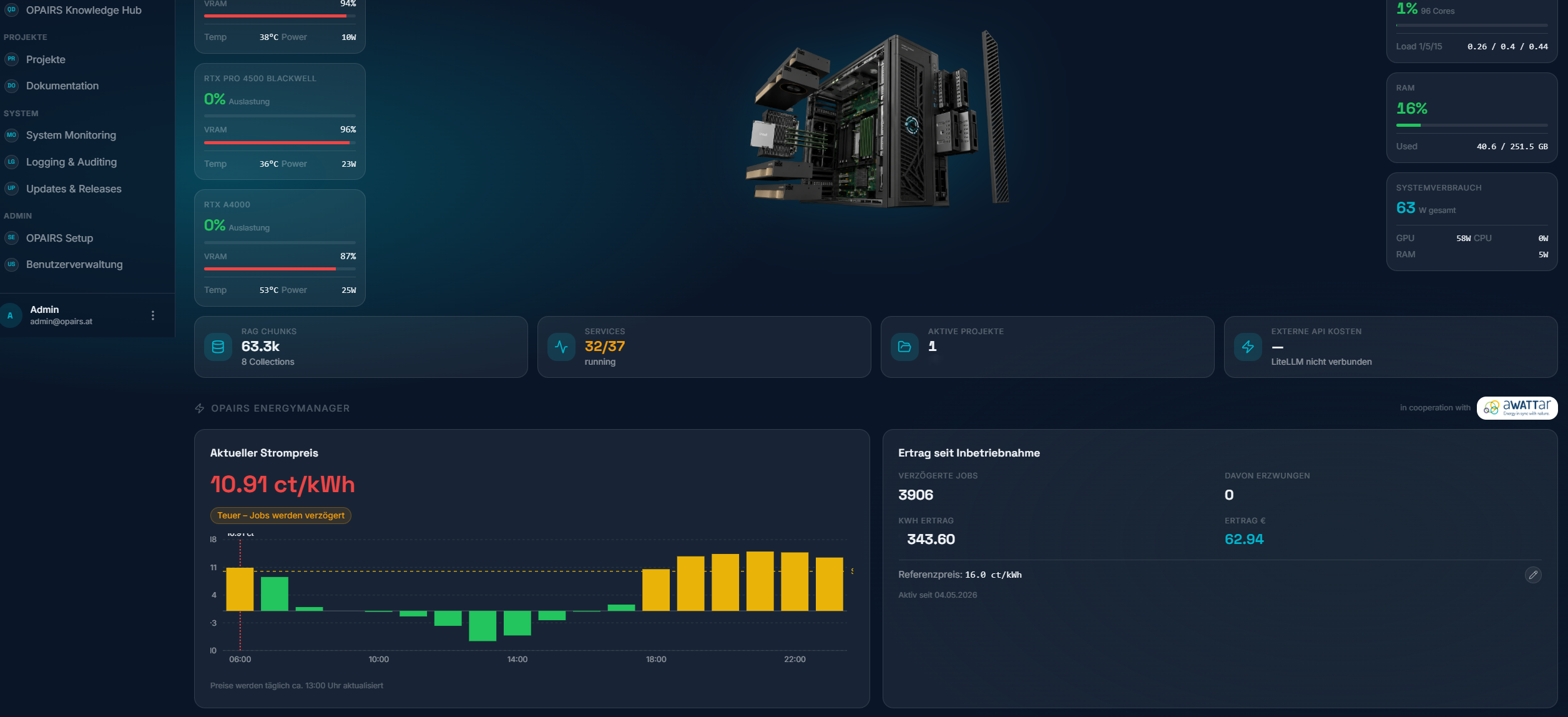
Measurable returns from day one
Since going live on 04.05.2026, the EnergyManager has documented every deferred job and calculated the return against the reference price. Over 3,900 deferred jobs, roughly 345 kWh processed in an optimized way, and over €63 in returns against the reference price of 16.0 ct/kWh, with zero forced aborts. The system genuinely waits; it does not cancel tasks. Capacity is fixed, and costs remain predictable.
System Consumption Scales with Load, Not with the Calendar
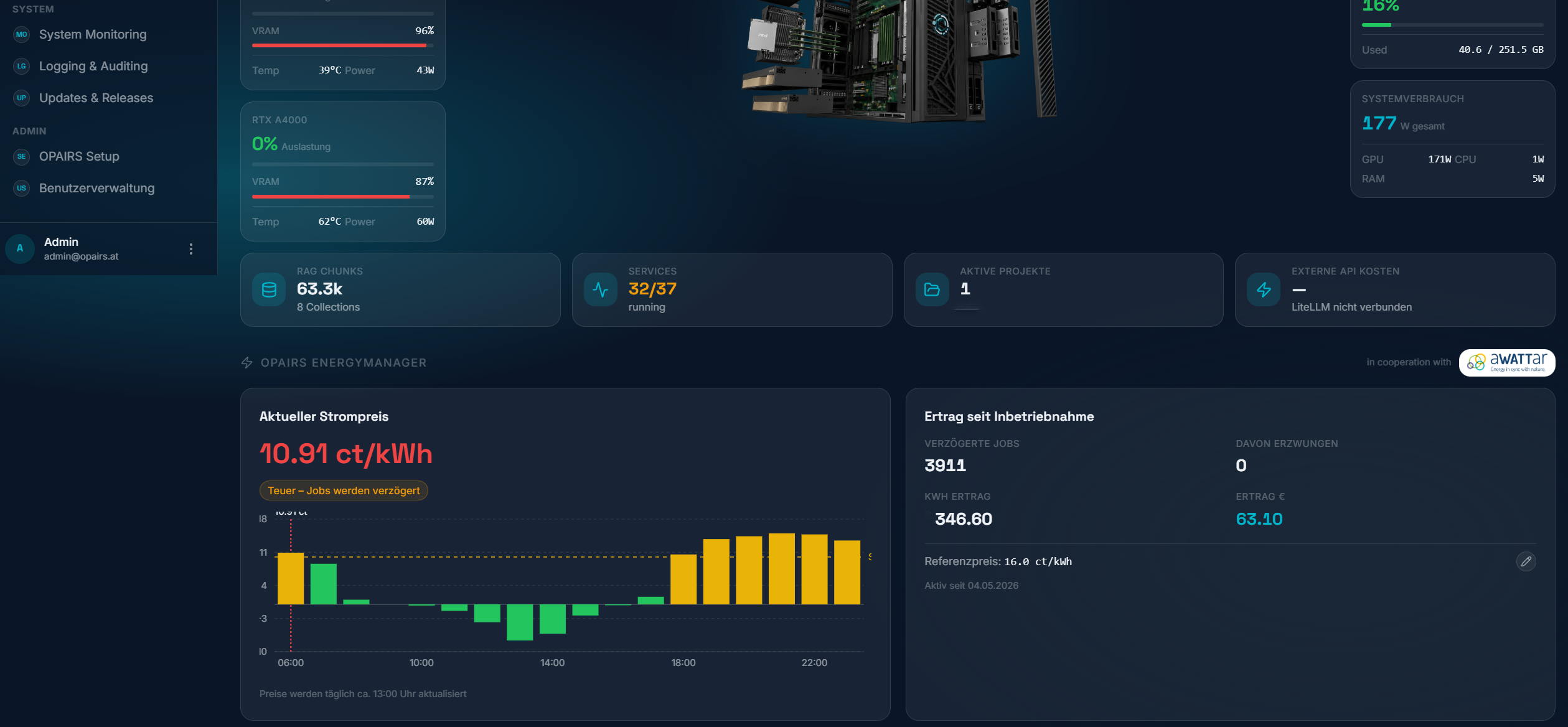
From 63 W idle to 177 W under load
The OPAIRS stack shows transparently what is actually being consumed: under 70 W total system consumption at idle, and up to 177 W under inference load, of which 171 W is GPU. This makes energy planning realistically calculable. Combined with the EnergyManager, it means peak load falls deliberately into low-price periods. What is a hidden operating expense for cloud providers becomes an actively controllable variable with OPAIRS.
ROI Impact: Energy Costs as an Active Variable in the TCO Model
Energy costs are a real line item in on-premise TCO calculations. The EnergyManager reduces this item not through less AI, but through better timing. Every optimized job directly improves the return on investment of the OPAIRS system, with no compromise on functionality. A detailed comparison of the total cost of ownership of on-premise versus cloud API can be found in the OPAIRS TCO comparison.
Outlook: Industrial Power Trading as the Next Expansion Stage
As soon as regulatory frameworks allow direct electricity exchange between industrial consumers and households (think decentralized energy markets and peer-to-peer trading under future EU mechanisms), OPAIRS is architecturally prepared. Manufacturing companies with their own PV systems could deliberately combine surplus generation capacity with inference load: AI infrastructure as an active participant in the energy market, not just a consumer.
More insights
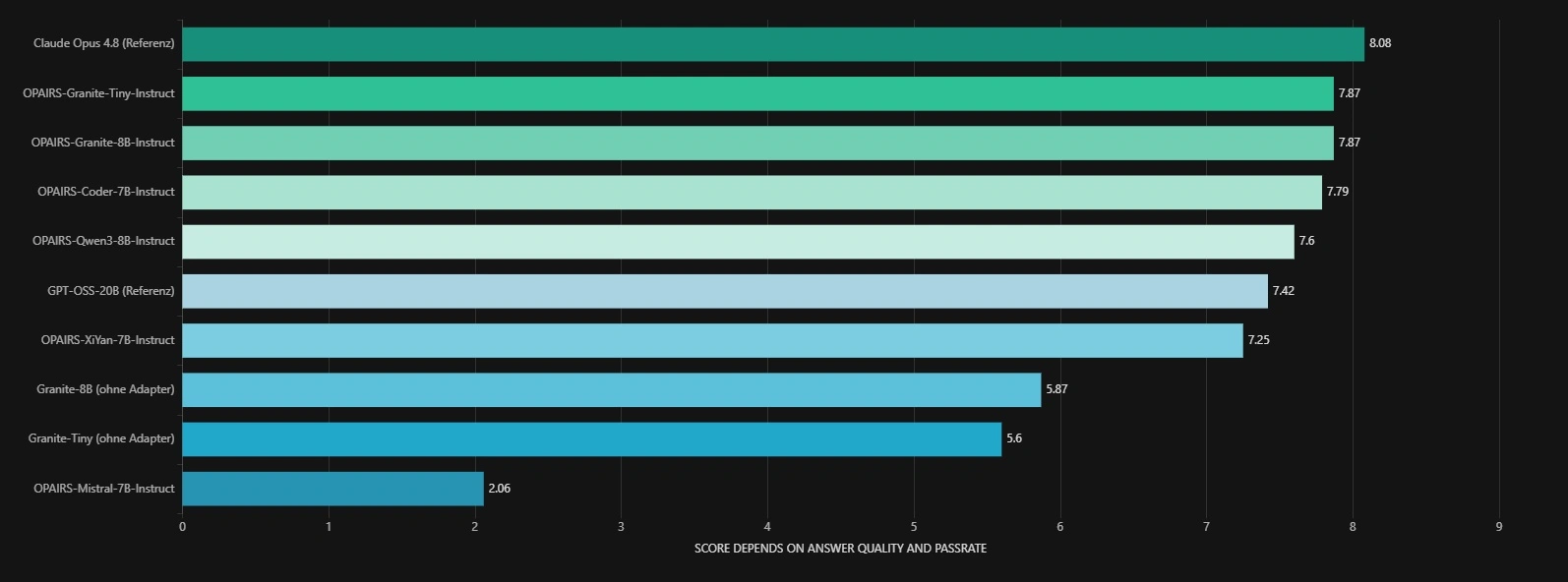
OPAIRS SQL Agent: Comparing Six LoRA Adapters for Industrial Databases
Six LoRA adapters, a 26-question catalog spanning PostgreSQL, T-SQL and Apache Iceberg databases, two external reference models: OPAIRS has systematically evaluated its SQL agent. Two Granite adapters lead the field. For production use, however, the deciding factors are not only answer quality but also speed, memory footprint, concurrency and the available context from ERP, MES, PLM and other industrial systems.
Read article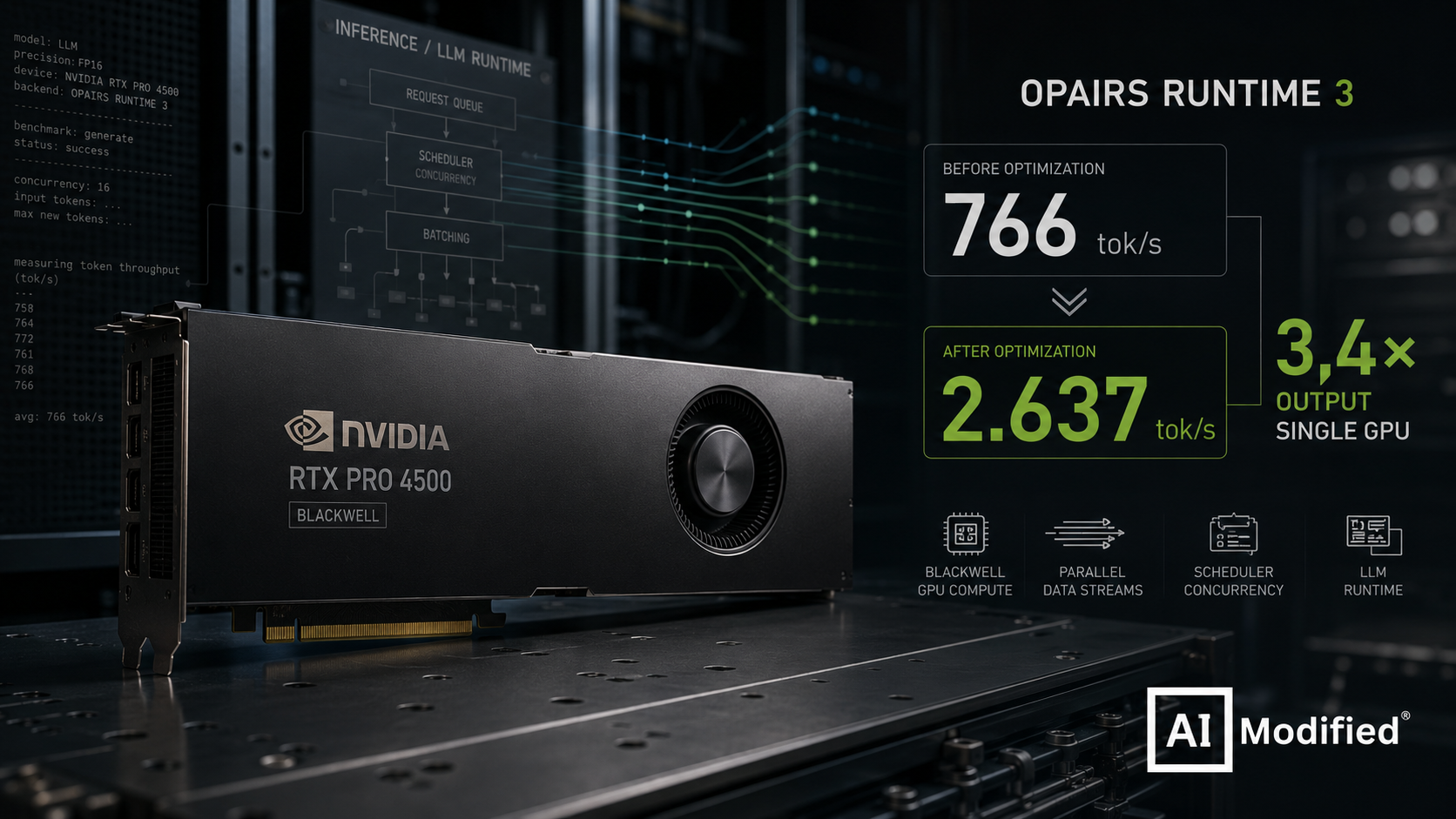
RTX PRO 4500 Blackwell: 3.4x LLM Throughput Through Runtime Optimization
Same GPU, same main model, up to 3.4x the output: OPAIRS Runtime 3 raises the throughput of GPT-OSS-20B on the RTX PRO 4500 Blackwell to up to 2,637 tokens/s. At the same time, the tests show why Qwen3.8-27B will not take over the production stack for now.
Read article