OPAIRS® Runtime 4: Why OPAIRS Puts Context Fidelity Before Throughput in Industrial AI
In August the question was: how many tokens per second can we get out of an RTX PRO 4500 Blackwell? Now it is: how many of them are usable? OPAIRS has switched the main model on its development system to Inkling 2 Mini. The new model is somewhat slower at medium load, but it does not invent sources and it marks what it does not know. gpt-oss-20b stays in the stack and does what it does best: highly structured output and fast access to structured knowledge from the data lake on the shop floor.

In the white paper “Industrial AI in Your Own Plant” we explain why industrial AI tasks differ from a general chat: an answer is only useful if it hits the right revision, the right project and the current plan, and if it is backed by a source. Wrong decisions cost material, deadlines or safety. This sets an uncomfortable consequence for model choice: the fastest model is not automatically the best if, when in doubt, it invents a standard part number or a source. Read the white paper: https://opairs-systems.com/en/whitepaper/industrial-ai-in-your-own-plant
Since 24 November 2026 the main model in the OPAIRS stack on our development system has therefore been Inkling 2 Mini from Thinking Machines Lab. gpt-oss-20b is not retired, it gets a clearly defined role. This report shows what we measured, where each model is strongest, what runtime work was needed and what follows for the AI BOM.
The problem was not throughput, it was the invented source
For the comparison we used 15 real, pseudonymised everyday requests: shop floor questions, knowledge search across documents (RAG), long texts, structured JSON output and tool calls. Both models received the same requests, and two independent AI reviewers scored the answers blind on a scale from 1 to 5.
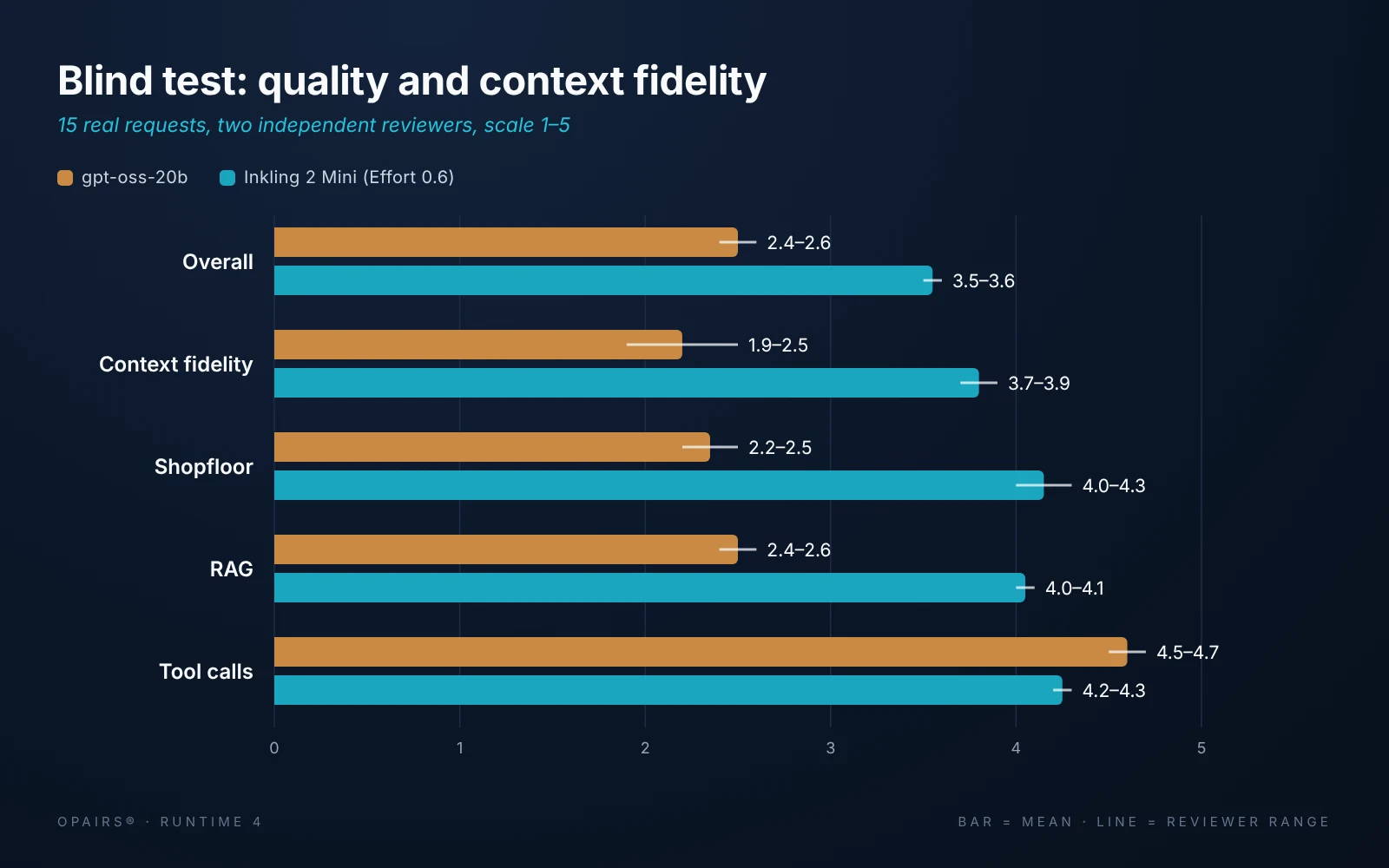
From 2.4–2.6 to 3.5–3.6, with context fidelity almost doubled
Overall, Inkling 2 Mini scores 3.5–3.6 out of 5 and gpt-oss-20b 2.4–2.6. The largest gap is in context fidelity, meaning whether the answer stays with what is in the data provided: 3.7–3.9 versus 1.9–2.5. The main reason is not a detail. gpt-oss-20b filled missing information with invented sources, standard parts and figures. Inkling 2 Mini marked the gaps. For tool calls, gpt-oss-20b is slightly ahead with 4.5–4.7 versus 4.2–4.3 for Inkling.
- Shop floor (5 requests): gpt-oss-20b 2.2–2.5 · Inkling 2 Mini 4.0–4.3
- RAG (4 requests): 2.4–2.6 · 4.0–4.1
- Long text (1 request): 3.0–3.3 · 4.0–4.7
- JSON with very tight token limits (3 requests): 1.0–1.1 · 1.0–1.1
- Tool calls (2 requests): 4.5–4.7 · 4.2–4.3
- Overall: 2.4–2.6 · 3.5–3.6; context fidelity: 1.9–2.5 · 3.7–3.9
To be fair: 15 requests and AI reviewers give a first, solid direction, not a final verdict. We will repeat the quality test with a larger prompt set and a domain review by users from manufacturing.
Throughput: where gpt-oss-20b stays ahead
Like gpt-oss-20b, Inkling 2 Mini is a mixture-of-experts model with around 3.4 billion active parameters, but through so-called looping it runs 48 layer passes per token. That costs compute and memory. We measured on the same RTX PRO 4500 Blackwell with 32 GB and 200 W, with the same client and a warm-up run each time.
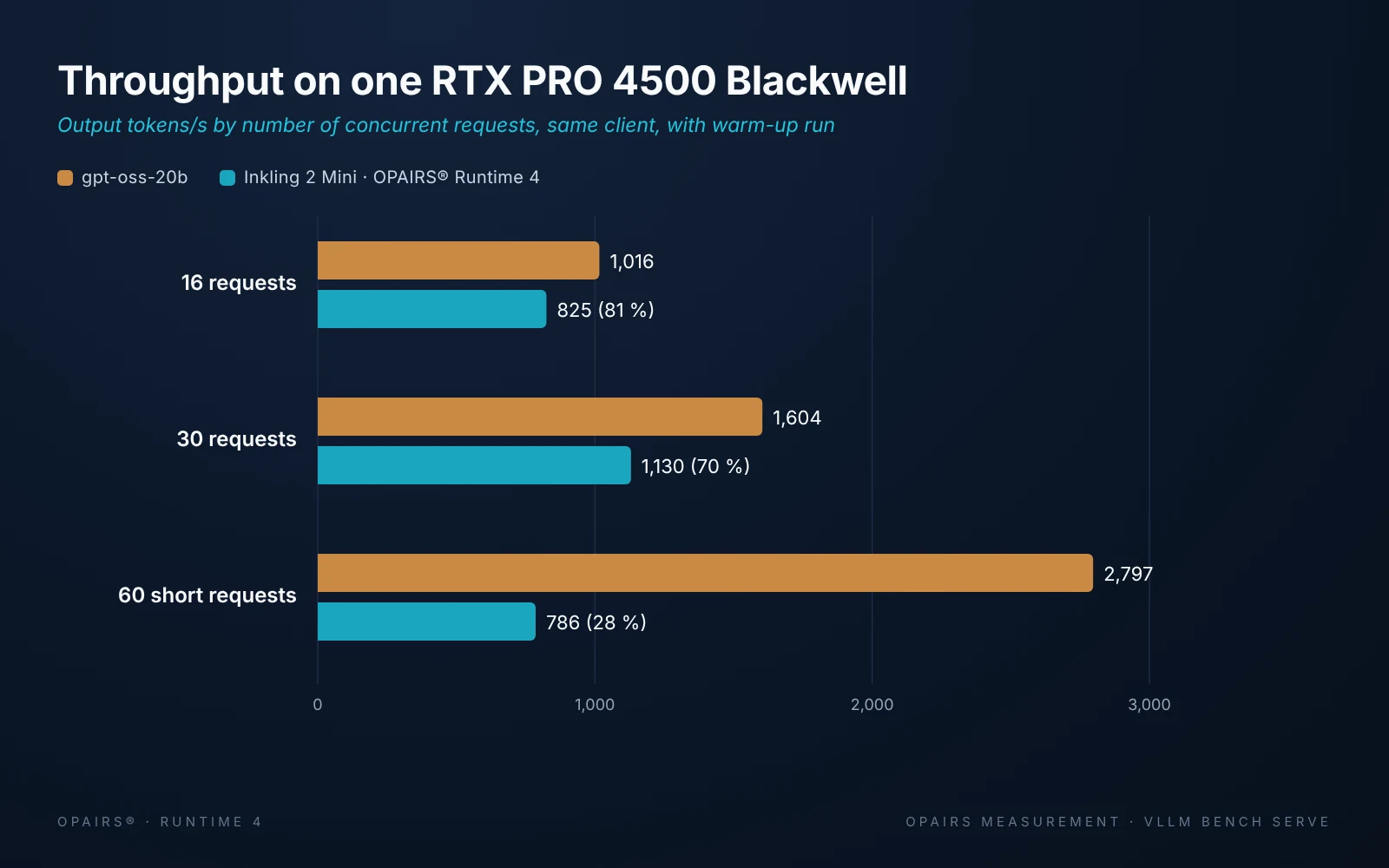
81 % at 16, 70 % at 30, 28 % at 60 concurrent requests
At 16 concurrent requests Inkling 2 Mini reaches 825 output tokens/s, 81 % of the gpt-oss throughput, with 0.26 seconds to the first token. At 30 requests it is 1,130 tokens/s or 70 %. At 60 short concurrent requests Inkling drops to 28 %. This is where gpt-oss-20b plays to its strength, and this is exactly what we keep using it for. The KV cache, the memory for running contexts, shrinks from around 656,000 to around 243,000 tokens. Instead of about ten full 65K requests, three to four fit on the card at once. The system works well up to about 30 concurrent requests.
- 1 request: gpt-oss-20b 163 tokens/s · Inkling 2 Mini 127–134 tokens/s (around 80 %)
- 16 requests: 1,016 · 825 tokens/s (81 %)
- 30 requests: 1,604 · 1,130 tokens/s (70 %)
- 60 short requests (512/256 tokens): 2,797 · 786 tokens/s (28 %)
- Power draw under load: gpt-oss-20b constantly at the 200 W limit · Inkling 2 Mini 176–191 W
OPAIRS® Runtime 4: Inkling 2 Mini on the workstation GPU, ahead of the official release
The official vLLM recipe for Inkling 2 Mini targets data-centre GPUs such as B200, GB200, H100 and H200 as well as DGX Spark. It does not list the RTX PRO Blackwell with its SM120 architecture, which is exactly the class of GPU found in workstations and servers in the plant. With the standard image our card ran generic kernels, speculative decoding (DSpark) did not start, and the usable context was 16K.
Runtime 4 closes this gap without waiting for the next vLLM release. It builds on the official launch image and takes over the specific fixes for SM120 that are already being worked on in the vLLM project. The host driver and CUDA stay unchanged. Four building blocks make the difference:
- SM120 kernel libraries from a current vLLM nightly build, ABI-checked against the launch image. All kernels now run natively on sm_120, and DSpark becomes usable.
- Conv-state reservation (vllm#69181): memory is reserved only for blocks that are actually readable. The KV cache grows from 42,139 to 242,936 tokens, the maximum context from 16K to 65K.
- Faster small GEMMs in decode (vllm#69168) for small batches on SM120.
- Bucketing of max_ctas (as in vllm#69288): instead of 112 to 146 Triton recompilations per run there are 0 to 1. Time to first token drops from up to 8.1 to 0.72 seconds. Outputs stay bit-identical: KL divergence 0.0, the first 32 tokens identical on all ten test prompts.
On top comes DSpark with seven speculative tokens. On real text about three tokens per step are accepted on average, giving around 40 % more throughput for a single request and 48 % at 16. Among other things we tested and rejected SGLang (memory pool full from about 30 requests, no FP8 KV cache on SM120) and the nightly image on its own (slower, newer CUDA version required).
Because every building block is based on a public fix in the vLLM project, the path ahead is clear. As soon as these fixes are part of an official release, Runtime 4 moves to the official image as part of regular maintenance. Nothing changes for users, except that they had the model earlier.
Context: what others get out of Inkling 2 Mini
Inkling 2 Mini has been available since 20 November 2026, and the first independent measurements are out. They show where an RTX PRO 4500 Blackwell with OPAIRS® Runtime 4 stands.
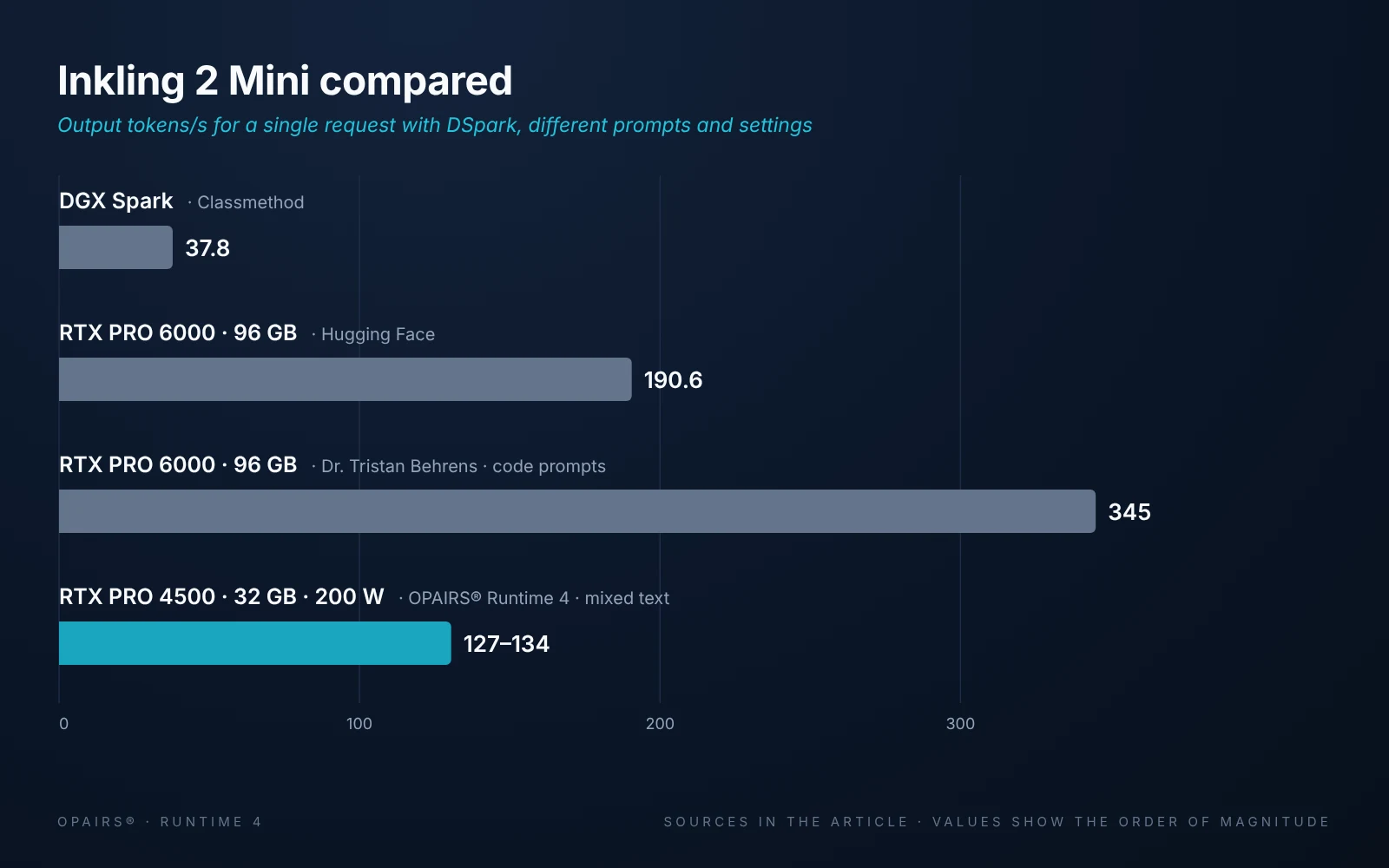
The RTX PRO 4500 next to the big RTX PRO 6000
Hugging Face optimised Inkling 2 Mini on an RTX PRO 6000 Blackwell with 96 GB and reaches 190.6 tokens/s for one user and 716 tokens/s for eight users with vLLM and DSpark. The RTX PRO 4500 has a third of the memory, half the memory bandwidth (896 instead of 1,792 GB/s) and a third of the maximum power (200 instead of 600 W). With OPAIRS® Runtime 4 it reaches 127–134 tokens/s for one request and 825 tokens/s at 16 concurrent requests. Relative to memory bandwidth, it is above the Hugging Face result for a single request. On a DGX Spark, a popular compact system for local AI, 37.8 tokens/s for one request and 133 tokens/s for eight requests were measured.
The RTX PRO 6000 at full load: measurement by Dr. Tristan Behrens
How much the big card delivers with Inkling 2 Mini was measured by Dr. Tristan Behrens on 22 November 2026 in his post “Eine Karte, eine Million Tokens” (one card, one million tokens) on an RTX PRO 6000, with his own SM120 image, DSpark and a 450 W power limit. With code prompts he reaches 345 tokens/s for one user and 3,688 tokens/s at 64 concurrent requests. At full load the card uses 0.12 joules per token, 1.33 joules for a single user. He, too, relies on his own SM120 image, on the same vLLM development state that Runtime 4 builds on. Running Inkling 2 Mini on RTX PRO Blackwell today takes an adapted runtime: https://lnkd.in/p/dsd3wArQ
- One request with DSpark: RTX PRO 4500 with Runtime 4 127–134 tokens/s (mixed text) · RTX PRO 6000 by Behrens 345 tokens/s (code)
- One request without speculation: RTX PRO 6000 by Behrens 168 tokens/s
- High concurrency: RTX PRO 4500 1,130 tokens/s at 30 requests · RTX PRO 6000 3,688 tokens/s at 64 requests
- Energy under load: RTX PRO 4500 about 0.16–0.23 J/token (16–30 requests, 176–191 W) · RTX PRO 6000 0.12 J/token (64 requests, 450 W)
- Maximum context: RTX PRO 4500 65,536 tokens, around 8.7 seconds to the first token for a full 64K request · RTX PRO 6000 1,043,399 tokens, 5.9 minutes to the first token
At full load the big card is more efficient per token, as it spreads its power across more concurrent requests. In return the RTX PRO 4500 stays below its 200 W limit, needs less space and cooling and costs considerably less to buy. Which card fits depends on the actual number of concurrent requests in the plant.
The effect of DSpark stands out. For Behrens, speculation doubles single-user throughput (factor 2.1), for Hugging Face it adds around 20 % over vLLM without speculation, for us around 40 % on mixed text. The difference lies in the content: code is highly predictable, so the draft head hits more often. Industrial requests with part numbers, tables, JSON and SQL are also highly structured. Whether DSpark works similarly well there is what we will measure next with real OPAIRS requests.
Two observations from the Hugging Face measurement match our work. There too, the combination of vLLM and DSpark was the biggest lever, with around 40 % more throughput over the baseline. And there too, Triton recompilations distorted the first measurement, which was worked around with an extra warm-up run. Runtime 4 fixes the cause, so recompilations stay away in live operation under changing load as well. Hugging Face reports results up to eight users, our measurements go up to 60 concurrent requests.
The vendor stresses efficiency too. Thinking Machines cites a Stanford-method “intelligence per watt” measurement on DGX Spark in which Inkling 2 Mini scores 0.703, well ahead of Qwen3.6-35B-A3B (0.430) and Gemma-4-26B-A4B (0.159). This fits our observation that the card runs at 176–191 W under load with Inkling instead of constantly at the 200 W limit.
The right model for the right task
Inkling 2 Mini thinks before every answer. How long is controlled by the so-called reasoning effort. This gives two profiles of the same model. Alongside them, two further models keep their fixed task:
- OPAIRS-Model-Base (effort 0.6) for chat, knowledge search, analyses and long documents.
- OPAIRS-Model-Base-Fast (effort 0.2) for standard requests, structured extraction, JSON and agent sub-steps. In ten standard requests with three runs each, Fast scored 4.9 out of 5 with an average total time of 1.63 seconds, without format or meta errors.
- gpt-oss-20b stays in use for highly structured output and for the shop floor. When a question at the workstation targets structured knowledge from the data lake, such as stock, order status or KPIs, the answer comes from the data, not from model knowledge. What counts there is speed, many short parallel requests and reliable tool calls. This is exactly where gpt-oss-20b leads: 4.5–4.7 out of 5 for tool calls and 2,797 tokens/s at 60 concurrent short requests.
- The specialised SQL model based on Granite remains responsible for queries on SAP and other databases.
This matches the approach of the white paper: no general-purpose model for everything, but specialised models with short contexts, each used for its task. Inkling 2 Mini writes where context, evidence and relationships matter. gpt-oss-20b delivers where structured data has to reach the shop floor quickly and in large numbers.
We tested and rejected an endpoint without any thinking. Inkling 2 Mini has no real no-thinking mode, and the known workarounds led to reasoning fragments in the answer text or to format errors. Fast is therefore the default for everything that needs to be quick.
What this means for the AI BOM
The switch is not an isolated model change. It confirms several theses from the white paper and from our article on the industrial knowledge base, and it sharpens one of them: https://opairs-systems.com/en/insights/unternehmenswissen-aufbauen-stueckliste-knowledge-hub
Backed answers beat fast answers. The white paper says: results need sources and approvals. A model that fills a missing delivery date confirmation with a plausible date is more dangerous in manufacturing than a slow model. The blind test shows that this property is measurable and varies strongly between models.
Structure makes the smaller KV cache workable. The AI BOM breaks a question into assigning, targeted querying, evidencing and answering. Because the SQL model only fetches the records needed and the knowledge graph only supplies the matching passages, contexts stay short. A model with a third of the KV cache suits this approach far better than one that loads entire stacks of documents into the context.
General model knowledge does not replace structure. Both models were weak on knowledge of SAP tables such as MARD, AFKO or QALS. This is exactly why a dedicated, SQL-specialised model queries the data in the OPAIRS stack. Gartner expects organisations to use small, task-specific models at least three times as often as general LLMs by 2027. Our measurement shows the reason in practice.
The AI OEE counts validated tokens, not tokens. Inference efficiency in the AI OEE is defined as validated tokens per watt. In raw terms, Inkling 2 Mini delivers somewhat fewer tokens per watt than gpt-oss-20b at medium load. But a token that invents a source is not validated and has no value. Conversely, for a structured query whose answer comes straight from the data lake, every fast token is a validated one. That is why OPAIRS assigns tasks by this metric. The peak of up to 2,637 tokens per second cited in the white paper refers to gpt-oss-20b in Runtime 3 and still applies to these structured tasks. For the new main model we plan with the values measured here.
A context of one million tokens is possible, but it is not the way. Inkling 2 Mini can process up to one million tokens, and Dr. Tristan Behrens confirmed this on the RTX PRO 6000: both test questions in 1,043,399 tokens were answered correctly. It did, however, take 5.9 minutes to the first token. Even a full 64K request takes around 8.7 seconds to the first token on our RTX PRO 4500. For a question at an assembly workstation neither is an option. This is exactly the argument of the white paper: instead of loading entire stacks of documents into the context, the AI BOM fetches the matching records and passages. Short contexts are not only more accurate, they are also why an answer comes in seconds rather than minutes and why an RTX PRO 4500 with 65K context is enough for everyday use.
Sizing remains a question of real load. A workstation or a single server is still enough for many use cases of a mid-sized manufacturer. When planning, keep in mind that concurrent requests are not the same as users. Agents, tool calls and background jobs create additional parallel sequences, as shown in our Runtime 3 report: https://opairs-systems.com/en/insights/rtx-pro-4500-blackwell-runtime-3-llm-optimierung. From about 30 concurrent requests, time to first token rises noticeably with Inkling. The cost model in our TCO comparison is therefore based on actual utilisation, not on the peak of a card: https://opairs-systems.com/en/insights/tco-on-premise-ki-vs-cloud-api
Figures only with evidence: the Research Agent as an example
The OPAIRS Research Agent, which went live in version 2.1 at the same time, shows what context fidelity means in everyday use. Sub-steps such as rewriting follow-up questions and the search run on the Fast profile, the final answer on Base. Figures only appear with evidence, and a check in the code adds a reference only if the figure appears verbatim in the source. Expert knowledge without a source is kept in a separate section. For a test question on sales figures in shipbuilding, the number of matching sources rose from zero to around nine out of twelve, and follow-up questions kept their reference in three out of three runs. A daily regression test with 66 checks safeguards this state.
Tested and reversible
Operations followed the same rule as for any change to a customer system. Before the switch we measured in three limited test windows, each with a watchdog that would have restored the original state automatically. The switch itself took about two minutes. All services access the main model through a central gateway, so only one entry had to change. gpt-oss-20b is fully preserved and can take over the main model role again at any time via script. Services with very tight token limits, such as invoice recognition, were moved to the Fast profile.
Status and next steps: rollout after validation with the customer
Inkling 2 Mini runs as the main model on the OPAIRS development system. We are now planning the rollout to customer installations, after a joint validation with the customer on their real requests and data. With Runtime 4 we do not have to wait for the official vLLM release: the new model is available today on existing RTX PRO Blackwell hardware, and the later move to the official image is a regular update.
In parallel we are working on several points: a larger quality test with a domain review by users from manufacturing, a measurement of the DSpark effect on real industrial requests, feedback of our single-GPU results to the vLLM project and a stricter evidence check in the Research Agent. In a follow-up article we will also show how many users an RTX PRO 4500 carries per use case, from the short shop floor question to document analysis.
The insight from this step sums up the idea of the white paper in one sentence: sovereignty is the prerequisite. Efficiency is the business. And in manufacturing, efficiency means the answer is right.
Technical references
- Thinking Machines Lab – Inkling 2 Mini: https://thinkingmachines.ai/news/inkling-2-mini/
- vLLM Recipe – Inkling-2-Mini: https://recipes.vllm.ai/thinkingmachines/Inkling-2-Mini
- Hugging Face – Hill-climbing Inkling 2 Mini inference on one RTX PRO 6000: https://github.com/huggingface/blog/blob/main/inkling-2-mini-inference-hillclimb.md
- Dr. Tristan Behrens (22 Nov 2026) – “Eine Karte, eine Million Tokens”, Inkling-2-Mini on an RTX PRO 6000 (German): https://lnkd.in/p/dsd3wArQ
- Classmethod – Inkling 2 Mini on DGX Spark: https://dev.classmethod.jp/en/articles/dgx-spark-inkling-2-mini-first-touch/
- NVIDIA – RTX PRO 4500 Blackwell (data sheet): https://www.nvidia.com/en-us/products/workstations/professional-desktop-gpus/rtx-pro-4500
- NVIDIA – RTX PRO 6000 Blackwell (data sheet): https://www.nvidia.com/en-us/products/workstations/professional-desktop-gpus/rtx-pro-6000/
- vLLM #69181 – Conv-state reservation on SM12x: https://github.com/vllm-project/vllm/pull/69181
- vLLM #69288 – Bucketing of max_ctas: https://github.com/vllm-project/vllm/pull/69288
- vLLM #69168 – GEMM optimisation for small batches on SM120: https://github.com/vllm-project/vllm/pull/69168
- vLLM #69081 – DSpark on SM120 in the launch image: https://github.com/vllm-project/vllm/issues/69081
- Gartner (2025) – Small, task-specific AI models: https://www.gartner.com/en/newsroom/press-releases/2025-04-09-gartner-predicts-by-2027-organizations-will-use-small-task-specific-ai-models-three-times-more-than-general-purpose-large-language-models
More background: the white paper “Industrial AI in Your Own Plant” shows how the AI BOM breaks complex tasks into solvable sub-tasks and why this is more economical locally than in the cloud: https://opairs-systems.com/en/whitepaper/industrial-ai-in-your-own-plant
For technical collaboration, benchmark results or a live demo in our showroom: office@opairs-systems.com
More insights
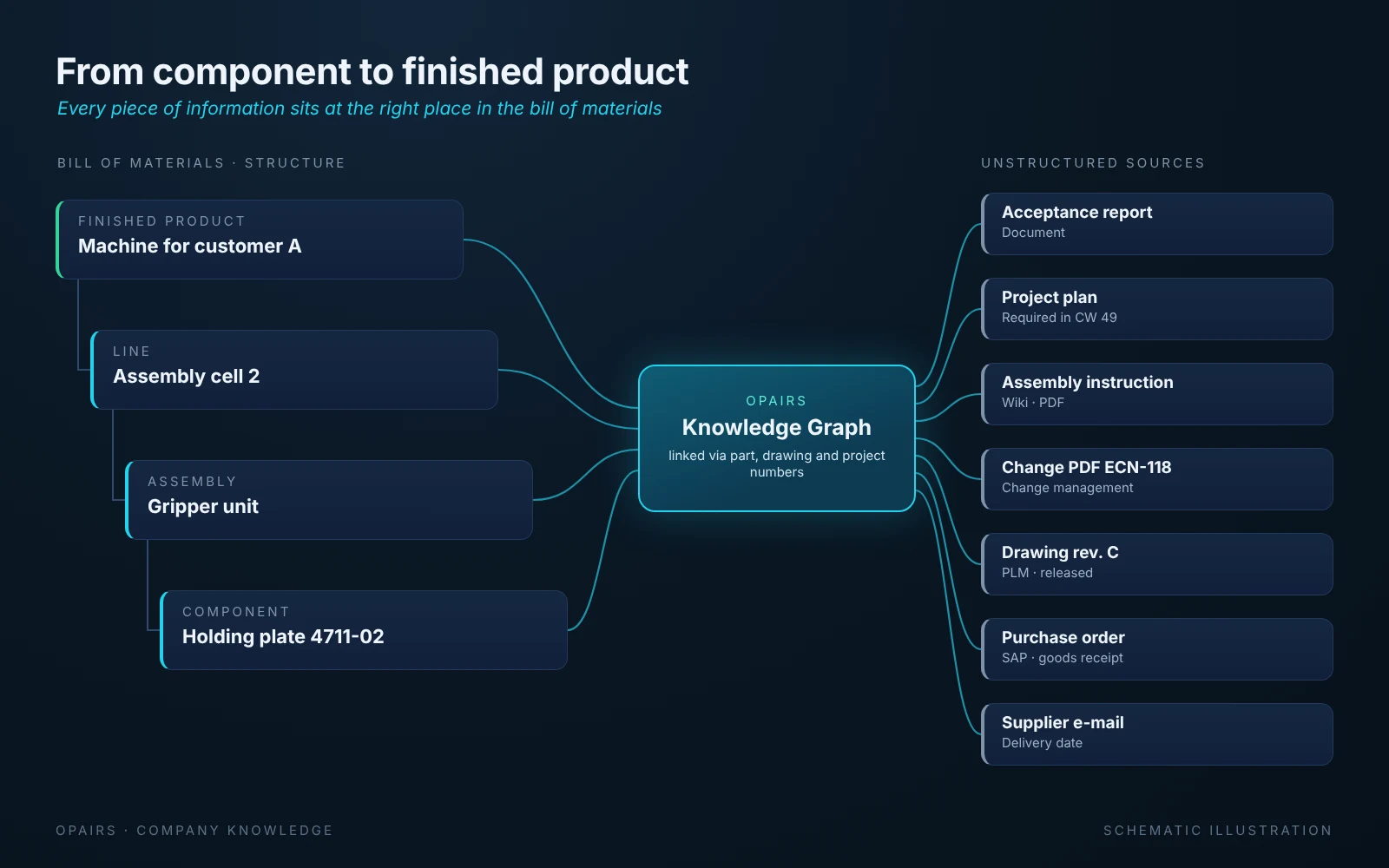
Industrial knowledge base with OPAIRS®: From the bill of materials to company knowledge for production, assembly and quotation costing
A part does not fit, assembly stops, and the worker starts searching: in SAP, in PLM, on the network drive, in the mailbox and among colleagues. OPAIRS organises company knowledge along the bill of materials, attaches drawings, changes and e-mails to the right component and reconciles them with the plan. Instead of searching, people get back to working on the product, and with every project the company’s own knowledge base on processes and production workflows grows.
Read article
From Excel Plan to Critical Path: How a Special Machinery Builder Manages Its Projects On-Premise
The project plan lives in Excel, while the actual status is spread across SAP, PLM, Teams and the lists kept by each department. A special machinery builder with around 100 million euros in revenue brings both together with OPAIRS: plan and actuals are compared, the critical path becomes visible and the AI derives recommendations. The result: up to 10% fewer project hours and up to 15% less search time. All data stays in-house.
Read article